
Welcome To Slotking India Storage System Pvt. Ltd.
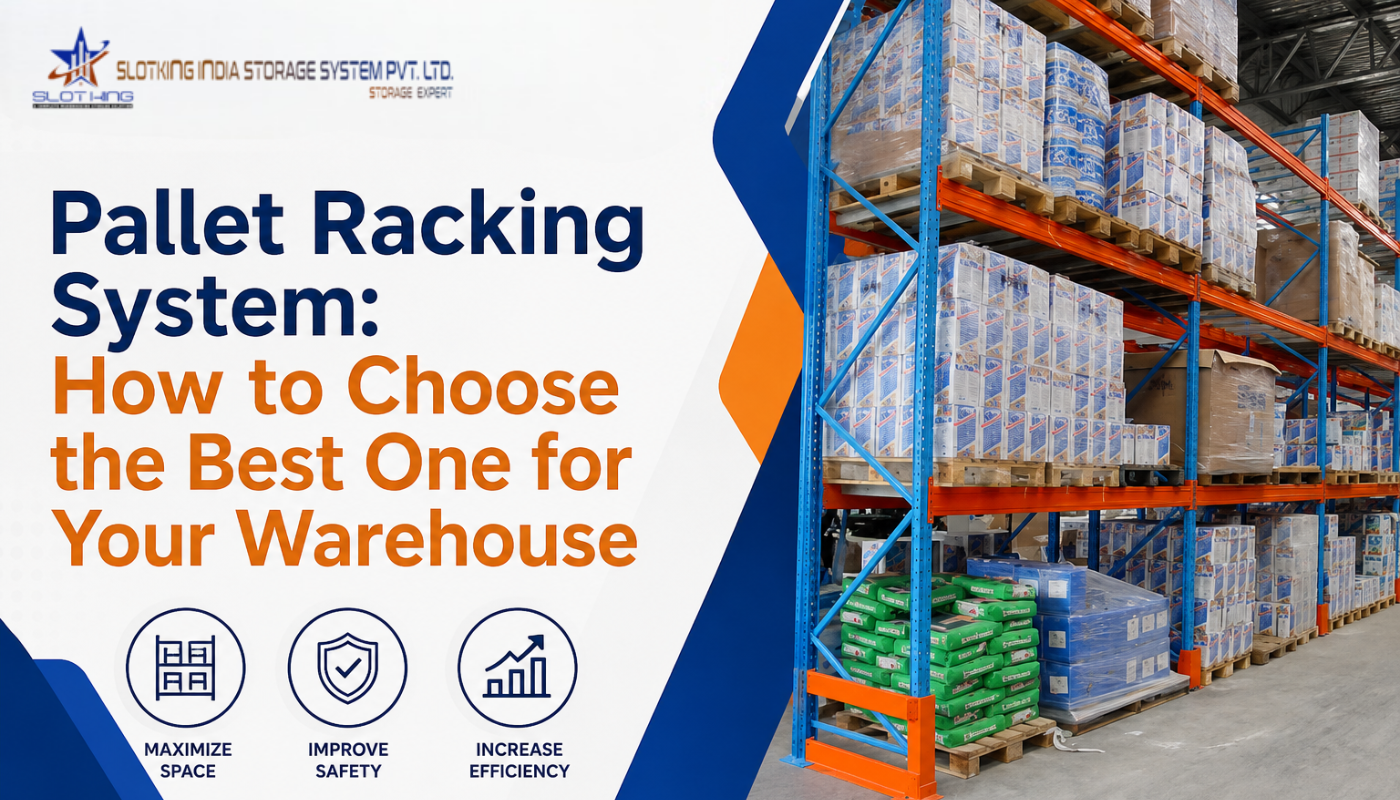
Choosing the right storage system for a warehouse is one of those decisions that quietly shapes everything, how fast orders move, how safely goods are stored, and how much of the floor space actually gets used. Many businesses invest in racking without fully thinking through what their warehouse actually needs, and end up with a setup that creates more problems than it solves.
A Pallet Racking System is not a one-size-fits-all purchase. The right configuration depends on what you store, how heavy it is, how often it moves, and what kind of handling equipment your team uses every day.
Most warehouses across manufacturing, FMCG, pharma, and logistics sectors rely on pallet racking as their primary storage method, and there are solid reasons for that. A well-designed Pallet Racking System uses both floor space and ceiling height together, which means storage capacity goes up without the footprint of the building changing at all.
Goods stored on pallets are easier to handle, safer to stack at height, and quicker to retrieve with a forklift or reach truck. When the racking is designed correctly, an operation that previously stored 300 pallets on the floor can store 900 or more within the same four walls. That kind of gain directly affects how much inventory a business can hold, how quickly it fulfils orders, and how much it pays per unit of storage.
The right rack type comes out of the inventory and operation, not the catalogue. Before speaking to any manufacturer, it helps to have clear answers to these:
What does an average pallet weigh? Load capacity per bay is the most critical specification. A system rated for 800 kg per level serves a completely different operation than one rated for 2,000 kg. Getting this wrong is a structural safety issue, not just an efficiency one.
How many different product lines do you carry? High SKU variety needs individual access to every pallet at all times. Fewer SKUs in large quantities open the door to denser storage configurations that would otherwise block access.
How fast does stock move in and out? Fast-moving goods need to be reachable from the aisle at any point in the day. Slow-moving or seasonal stock can go deeper into the rack structure, where access takes a little longer.
What is the maximum reach height of your forklift? This determines the practical ceiling on rack height. A warehouse with 30-foot ceilings and a forklift that reaches 15 feet can only use half that height, an important constraint to factor in before designing any system.
Selective Pallet Racking - Direct Access to Every Single Pallet
The most commonly used system across warehouses in India is the most flexible. Every pallet has its own bay and can be accessed directly from the aisle without disturbing surrounding stock.
This suits warehouses with a wide variety of products and regular daily picking. Pallet storage rack in a selective configuration scales easily, extra bays can be added as inventory grows without redesigning the whole system. The trade-off is that wider aisles are needed for forklift movement, which takes up some floor space.
Drive-In Pallet Racking - Maximum Storage Density for Bulk Goods
Drive-in racking eliminates the individual aisle between bays. The forklift drives directly into the rack structure itself to place or retrieve pallets, which means far more pallets fit in the same floor area.
The trade-off is retrieval order. Drive-in systems work on a last-in-first-out basis, the most recently stored pallet comes out first. This works well for bulk goods, seasonal stock, or large quantities of a single product where strict rotation isn't required.
Push Back Pallet Racking - Depth Storage With Better Stock Rotation
Push back racking stores pallets two to five deep on inclined rails. When the front pallet is removed, the one behind it rolls forward automatically. Loading happens from the front on the same side.
This gives better stock rotation than drive-in racking while still achieving good storage density. For warehouses that need more capacity than selective racking provides but can't work with a purely last-in-first-out system, push back is a practical middle option.
Cantilever Racking - Built for Long, Oversized, or Irregular Materials
Not every warehouse stores goods that fit neatly on a standard pallet. Steel pipes, timber, long profiles, rolled sheet metal, and large machine parts need open horizontal storage without the front uprights that standard racks use.
Cantilever racking handles exactly this. Arms extend outward from a central column with no obstruction, allowing long or awkward materials to be loaded and retrieved cleanly. For manufacturing yards, steel stockists, or any facility handling non-palletised bulk materials, this is the only system that works properly.
The type of racking system matters, but so does the quality of the materials and construction behind it. A few things to check before committing to any supplier:
Steel grade - High-tensile mild steel holds its shape under sustained load without deflection. Cheaper steel bends over time, especially at higher bay levels where stress concentrates.
Beam adjustability - Beam heights should be changeable to accommodate different pallet sizes as inventory evolves. Fixed-height systems become a liability the moment storage needs change.
Floor anchoring - Every rack must be properly anchored into the warehouse floor. This becomes increasingly important as rack height increases. An improperly anchored rack is a risk to people and goods.
Surface treatment - Powder-coated or galvanised finishes protect against rust and corrosion, which matters considerably in high-humidity warehouses or cold storage environments.
Slotking India Storage System Pvt. Ltd., headquartered in New Delhi, manufactures pallet racking systems built specifically for the conditions Indian warehouses face temperature variation, high inventory turnover, and the need to make the most of available space.
Their process begins with a site survey. The team visits the warehouse, assesses ceiling height, floor load capacity, column positions, sprinkler system placements, and existing handling equipment before designing anything. The racking system that comes out of that process fits the actual space, not a showroom floor.
A pallet rack is one of the most used pieces of infrastructure in any warehouse. It touches every picking operation, every storage decision, and every square foot of floor plan. Choosing the wrong type means living with the consequences every working day.
The decision comes down to inventory type, SKU count, stock rotation requirements, and handling equipment. Get those four things clear, match them to the right racking configuration, and make sure the manufacturer behind the system builds to a standard that holds up over years, not just months.
Talk to Slotking India and Get a Racking System Built for Your Warehouse
Slotking India offers selective pallet racks, drive-in systems, push back configurations, cantilever racking, and complete warehouse storage solutions, all manufactured in-house and installed by their own team. Contact the team today for a free site survey and find out exactly which pallet racking system fits your warehouse.